
Navarrete vs Foster Breakdown: Chaos Meets Defensive Mastery in San Antonio
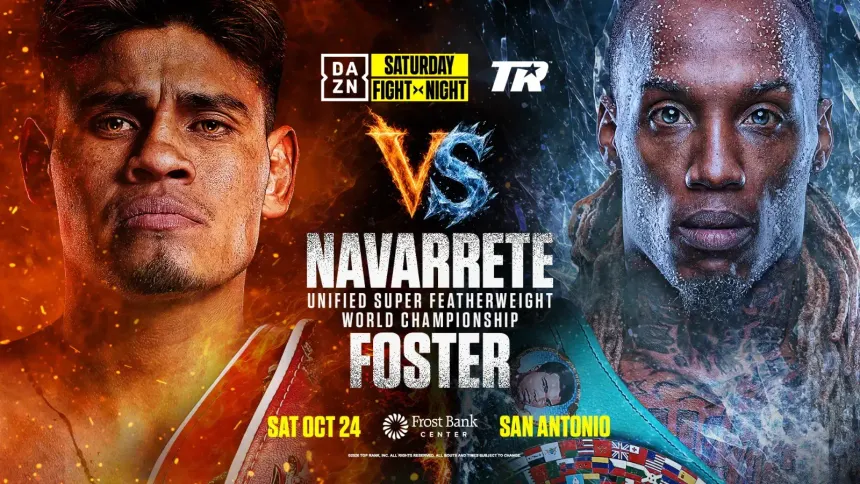
This Navarrete vs Foster breakdown examines one of the most compelling stylistic matchups available in boxing.
Emanuel “Vaquero” Navarrete and O’Shaquie “Ice Water” Foster will meet in a three-belt super featherweight unification fight on Saturday, October 24, at the Frost Bank Center in San Antonio, Texas.
Navarrete will place his WBO and IBF titles on the line, while Foster enters with the WBC championship. Beyond the belts, the contest will determine the leading fighter in the 130-pound division and move the winner within one title of becoming undisputed champion.
The matchup offers an extreme contrast in boxing philosophies.
Navarrete creates disorder. He attacks with relentless volume, unusual combinations and punches launched from angles that frequently appear technically incorrect. His balance can look compromised, but the awkwardness makes it extremely difficult for opponents to anticipate what is coming next.
Foster operates through control. He uses subtle upper-body movement, lateral steps, distance management and precise counterpunching to reduce an opponent’s effectiveness. He does not need to dominate every second of a round. Instead, he waits for mistakes and answers with the cleaner punches.
The central question is whether Navarrete’s pressure and irregular rhythm can overwhelm Foster’s defensive structure—or whether Foster can punish the Mexican champion every time he falls out of position.
Fight Details
| Detail | Information |
|---|---|
| Fight | Emanuel Navarrete vs O’Shaquie Foster |
| Date | Saturday, October 24, 2026 |
| Venue | Frost Bank Center, San Antonio, Texas |
| Division | Super featherweight |
| Weight limit | 130 pounds |
| Distance | 12 rounds |
| Titles | WBO, IBF and WBC |
| Navarrete’s record | 40-2-1, 33 KOs |
| Foster’s record | 25-3, 12 KOs |
| Broadcast | DAZN |
| Promoter | Top Rank |
Tale of the Tape
| Fighter | Emanuel Navarrete | O’Shaquie Foster |
|---|---|---|
| Nickname | Vaquero | Ice Water |
| Record | 40-2-1, 33 KOs | 25-3, 12 KOs |
| Nationality | Mexican | American |
| Current titles | WBO and IBF | WBC |
| Championship divisions | Three | One |
| Primary strength | Volume and irregular angles | Defense and counterpunching |
| Preferred range | Mid-range | Long to mid-range |
| Recent result | TKO 11 vs Eduardo Núñez | MD 12 vs Raymond Ford |
How Navarrete Reached Unification
Emanuel Navarrete enters this fight after producing one of the strongest performances of his recent career.
The Mexican champion defeated Eduardo Núñez to add the IBF title to his WBO championship. Navarrete took control by pressing forward, using his superior reach and repeatedly landing hooks and uppercuts from unconventional positions.
Núñez entered with a reputation as a dangerous puncher, but he struggled to establish a consistent offensive rhythm. Navarrete’s reach, activity and ability to attack from outside the expected punching lanes prevented Núñez from settling.
The damage accumulated as the fight progressed. Cuts and swelling around Núñez’s eyes eventually forced the ringside physician to stop the contest at the beginning of the eleventh round.
It was an important performance for Navarrete.
Before facing Núñez, questions had emerged about his condition and long-term trajectory. His move to lightweight had not worked as planned, and his performance against Denys Berinchyk lacked the energy and sustained aggression usually associated with “Vaquero.”
Navarrete then encountered significant difficulty against Charly Suarez. The Filipino challenger’s speed and counterpunching repeatedly exposed openings in Navarrete’s wide attacks, demonstrating how a disciplined fighter can capitalize when the Mexican champion overcommits.
The Núñez victory restored some momentum.
Navarrete appeared physically sharper at 130 pounds and more committed to applying intelligent pressure. Instead of throwing purely for the sake of activity, he used his punches to progressively break down his opponent.
Foster, however, presents a completely different challenge.
Núñez remained available for many of Navarrete’s attacks. Foster specializes in denying clean targets, changing angles and making opponents pay for reaching.
How Foster Reached Unification
O’Shaquie Foster arrives in San Antonio after retaining his WBC title against Raymond Ford.
The fight began as a closely contested tactical battle. Ford found moments of success during the opening rounds, particularly when Foster overextended or allowed himself to be pushed toward the ropes.
Foster gradually adjusted.
He increased his activity, took greater control of the distance and began landing the cleaner right hands. His jab became more influential during the second half, while his defensive movement prevented Ford from sustaining combinations.
Foster also demonstrated that he is more than a pure back-foot counterpuncher.
Rather than waiting for Ford to initiate every exchange, he stepped forward behind the jab and forced the challenger to reset. That adjustment proved decisive during the middle and late rounds.
The victory continued a strong run for Foster.
He reclaimed the WBC championship from Robson Conceição after losing a highly controversial decision in their first meeting. He then produced a controlled performance against Stephen Fulton before defeating Ford by majority decision.
Those contests demonstrated Foster’s versatility.
Conceição required Foster to be more assertive. Fulton tested his ability to manage another highly technical boxer. Ford forced him to make adjustments against a younger opponent with speed, athleticism and southpaw movement.
Navarrete will now test his ability to remain composed under a completely different form of pressure.
Navarrete’s Organized Chaos
Navarrete is often described as awkward, but that description does not fully explain why his style is effective.
His awkwardness is not simply the result of poor technique. It is a functional system built around disrupting an opponent’s expectations.
Most boxers attack from recognizable positions. Their shoulders, hips and feet provide visual information before the punch arrives. Navarrete frequently breaks those patterns.
He throws hooks with the arm extended. He launches uppercuts from outside traditional uppercut range. He leans his body forward, changes the height of his delivery and allows combinations to continue after his feet appear to be out of position.
Opponents cannot rely on standard defensive reactions because the punches do not arrive along standard trajectories.
A conventional high guard may block the first shot but leave an opening for a looping punch around the side. A backward step may avoid the initial attack but place the opponent at the end of Navarrete’s long uppercut.
His unusual delivery also disguises his power.
Navarrete can generate force without appearing completely set. He may not always punch with textbook balance, but his length and rotational movement allow him to produce damaging shots from unexpected positions.
The danger increases when he establishes rhythm.
Once Navarrete begins throwing in sustained sequences, opponents become preoccupied with defending rather than creating their own offense. Even when many of his punches miss or strike the guard, the volume can make it difficult for the other fighter to respond.
That pressure is physical, tactical and psychological.
The Cost of Navarrete’s Style
The same qualities that make Navarrete dangerous also create opportunities for Foster.
Navarrete regularly finishes combinations with his weight too far forward. His feet can cross during an attack, while his wide hooks sometimes leave the center of his guard exposed.
He also tends to pull straight back after throwing rather than exiting at an angle.
Against an opponent who is simply trying to survive, those flaws may not matter. Against an elite counterpuncher, they can become the central story of the fight.
Foster will not need to match Navarrete punch for punch. He needs to identify the moment when Navarrete loses balance and land before the Mexican champion can recover his position.
The straight right hand should be particularly important.
Navarrete often creates an opening through the middle when he loops his left hook or leans forward behind a long combination. Foster can use a short step back to create space before driving the right hand down the center.
The left hook is another possible counter.
If Navarrete enters with his upper body ahead of his feet, Foster can turn him with the lead hand and exit laterally. The objective will be to make Navarrete pay without remaining in position for the follow-up attack.
Foster’s Defensive Structure
Foster’s defense is based on small, efficient movements.
He does not always retreat completely out of range. Instead, he makes punches miss by narrow margins, allowing him to remain close enough to counter.
His shoulder roll helps redirect right hands, while his rear hand remains available to block hooks or protect the side of his head. He also uses subtle changes in elevation to alter the target without surrendering his position.
The lateral step is one of his most important tools.
When opponents move forward, Foster rarely wants to retreat directly toward the ropes. He takes a short step to either side, forcing the aggressor to turn before launching another attack.
That movement interrupts combinations.
An opponent may begin an attack expecting Foster to remain directly in front of him, only to discover that the target has moved outside the natural line of the next punch.
Foster then uses the reset to counter.
His defensive intelligence is particularly effective against fighters who become impatient. The more aggressively an opponent reaches, the more opportunities Foster has to create a miss and answer with a clean shot.
Navarrete will provide him with opportunities, but also a level of unpredictability that makes every defensive decision more complicated.
Why the Shoulder Roll Is Risky
Foster’s shoulder roll can neutralize conventional right hands, but Navarrete does not attack conventionally.
The Mexican champion’s looping punches can travel over or around the lead shoulder. His uppercuts can also split a defense designed primarily to redirect straight shots.
Foster cannot depend on a single defensive position.
If he remains stationary with his lead shoulder raised, Navarrete may attack around the guard, target the body or continue punching until an opening appears.
The length of Navarrete’s combinations is especially important.
Foster may successfully avoid the first two punches and still find himself defending a third, fourth or fifth shot. His usual countering window could disappear if Navarrete refuses to stop throwing.
For that reason, Foster’s feet may be more important than his upper-body defense.
He needs to combine slips and rolls with lateral movement. Making Navarrete miss while remaining directly in front of him will not be enough. Foster must exit the exchange before the next unconventional punch arrives.
The Battle for Distance
Distance management will determine which fighter imposes his preferred type of contest.
Foster wants enough space to read Navarrete’s initial movement. From the outside, he can use his jab, control the pace and force the Mexican to cover additional ground before attacking.
Navarrete wants to operate at the edge of mid-range.
That is where his reach, irregular uppercuts and looping hooks become most difficult to read. He does not necessarily need to fight chest-to-chest. He needs to remain close enough to launch repeated attacks without allowing Foster a complete reset.
The jab will be essential for both fighters.
Foster can use it as a measuring tool and a barrier. A consistent jab to the head and chest would interrupt Navarrete’s forward movement and make it more difficult for him to begin combinations with clean balance.
Navarrete’s jab serves a different purpose.
He often uses the lead hand to distract or obstruct rather than simply score. Once Foster reacts to the jab, Navarrete can change the angle and launch a wider power punch from outside the defender’s field of vision.
The fighter who wins the lead-hand battle will have a major advantage in controlling the geometry of the fight.
Can Foster Control the Pace?
Foster’s ideal contest is measured.
He wants exchanges to have clear beginnings and endings. He prefers enough time between attacks to study reactions, adjust his position and identify the most efficient counter.
Navarrete wants to eliminate that structure.
The Mexican champion will try to extend exchanges beyond the point where Foster expects them to finish. Even if Foster blocks or avoids the first combination, Navarrete may immediately begin another attack before the American can reestablish his stance.
This is where volume becomes more than a punch statistic.
Navarrete’s activity can force Foster to process information continuously. Every unusual angle creates another defensive question, and every extended sequence delays Foster’s opportunity to respond.
Foster must avoid becoming too passive.
Making punches miss is valuable, but defense alone does not win rounds. He needs to produce visible counters that clearly separate his clean work from Navarrete’s less accurate volume.
That balance has occasionally been a problem for Foster.
His controlled style can produce close rounds because judges may favor the fighter who appears to be creating more of the action. Against Navarrete, the contrast between activity and accuracy will be impossible to ignore.
Can Navarrete Sustain the Pressure?
Navarrete’s route to control depends on maintaining his output without becoming reckless.
He cannot chase Foster around the ring with single, exaggerated attacks. Foster is too intelligent and too comfortable countering opponents who fall over their front foot.
Instead, Navarrete must use controlled pressure.
He should jab to the chest, attack the body and gradually reduce Foster’s available space. Targeting the torso would also prevent Foster from relying entirely on head movement.
Navarrete’s body punching could become a decisive tactical element.
Foster is excellent at moving his head and rolling with shots, but his body cannot move as far without affecting his balance. Long punches underneath the elbows could slow his lateral movement and make him more stationary during the second half.
Navarrete must also resist the temptation to load up after landing cleanly.
The objective is not to end every exchange with one spectacular punch. It is to keep Foster under pressure, force repeated defensive reactions and prevent him from settling into a predictable countering rhythm.
Foster’s Counterpunching Windows
Foster will have several clear opportunities to counter.
The first should appear when Navarrete reaches with the lead hand. Foster can pull back slightly, allow the punch to fall short and return with a straight right before Navarrete recovers his stance.
The second opportunity will come at the end of combinations.
Navarrete often remains vulnerable after completing an extended attack. If Foster can identify the final punch, he can step around the Mexican champion and counter from the new angle.
The third window should emerge when Navarrete attempts the long uppercut.
That punch is dangerous because of its reach, but it also travels a considerable distance. Foster can take a half-step back and answer over the top if his timing is precise.
Body counters may be equally important.
Navarrete’s high-volume attacks can leave his torso exposed. A sharp right hand to the body could interrupt his rhythm and discourage him from throwing extended combinations without resetting his feet.
Foster does not need to hurt Navarrete with every counter. He needs to make the Mexican hesitate.
Even a brief reduction in Navarrete’s output would give Foster more control over the pace.
The Body-Punching Battle
Both fighters have tactical reasons to attack the body.
Navarrete should use body shots to reduce Foster’s mobility. Head-hunting would allow the American to showcase his shoulder roll, reactions and lateral movement.
Punching underneath the guard would make those defensive movements more physically expensive.
Foster’s body attack would serve a different purpose.
Navarrete’s style requires significant energy. His long combinations, constant forward movement and irregular shifts place demands on his legs and core.
Clean body counters could gradually reduce that output.
Foster should particularly target Navarrete when the Mexican’s upper body moves too far ahead of his hips. At that moment, Navarrete may be unable to absorb a body shot without losing his balance.
The boxer who commits to the body early may create the decisive openings later.
The Scoring Dilemma
Navarrete vs Foster could produce several difficult rounds to score.
Navarrete may throw significantly more punches, force the action and keep Foster moving. Foster may land fewer shots but connect with greater accuracy and defensive clarity.
Judges are supposed to prioritize clean, effective punching.
In practice, sustained pressure, visible activity and crowd reaction can influence how a close round is perceived. That could become especially relevant in San Antonio, where Navarrete is likely to receive considerable support.
Foster must make his counters obvious.
A subtle defensive move followed by a short punch may demonstrate technical control, but it can be overshadowed by a long Navarrete combination—even if most of the Mexican’s punches fail to land cleanly.
Foster’s best rounds will be those in which he finishes exchanges with the final visible punch and then moves away before Navarrete can respond.
Navarrete must ensure that his pressure is productive rather than merely dramatic.
Walking forward and throwing is not enough. His aggression must create clean punches, force Foster into uncomfortable positions or prevent the American from executing his offense.
The difference between pressure and effective pressure could determine several rounds.
Where the Fight Changes
The most revealing stage of the contest should arrive between rounds five and eight.
During the opening rounds, Foster will attempt to establish distance and collect information about Navarrete’s timing. Navarrete, meanwhile, will test the American’s reactions with jabs, feints and irregular power punches.
By the middle rounds, both fighters should have identified the other’s primary patterns.
That is when adjustments become critical.
If Foster begins stepping around Navarrete and landing the straight right consistently, the Mexican will need to tighten his attacks and reduce the distance more intelligently.
If Navarrete succeeds in trapping Foster near the ropes, the American will need to increase his physicality, clinch when necessary and prevent long combinations from developing.
The second half will reveal whether Foster can maintain defensive concentration under constant pressure.
It will also reveal whether Navarrete can preserve his output without sacrificing balance.
What This Fight Means at 130 Pounds
This contest is more than a conventional title unification.
Navarrete and Foster have separated themselves from the rest of the super featherweight division through contrasting forms of excellence. Navarrete brings the deeper record of stoppages and championship success across multiple weight classes. Foster brings one of the strongest recent résumés in the division and a style capable of neutralizing highly skilled opponents.
The winner will leave San Antonio with three of the four recognized world championships.
That position would create a clear route toward an undisputed title fight.
It would also settle the immediate debate over the leading fighter at 130 pounds. Navarrete currently represents the division’s most destructive and unpredictable offensive force. Foster represents its most sophisticated defensive operator.
Their confrontation will determine which philosophy can control the division.